English
 简体中文
 Español
 Português
 русский
 Français
 日本語
 Deutsch
 tiếng Việt
 Italiano
 Nederlands
 ภาษาไทย
 Polski
 한국어
 Svenska
 magyar
 Malay
 বাংলা ভাষার
 Dansk
 Suomi
 हिन्दी
 Pilipino
 Türkçe
 Gaeilge
 العربية
 Indonesia
 Norsk
 تمل
 český
 ελληνικά
 український
 Javanese
 فارسی
 தமிழ்
 తెలుగు
 नेपाली
 Burmese
 български
 ລາວ
 Latine
 Қазақша
 Euskal
 Azərbaycan
 Slovenský jazyk
 Македонски
 Lietuvos
 Eesti Keel
 Română
 Slovenski
 मराठी
 Srpski језик


Wall space is often the most underused surface in a home, classroom, or office. A product that combines modular geometry, natural material performance, and tool-free installation can turn empty walls into functional display zones without permanent damage. This article examines why Hexagon Cork Board Tiles Self Adhesive Pin Board have become a preferred choice for designers, facility managers, and DIY users. It covers material properties, acoustic behavior, layout strategies, installation steps, maintenance routines, and answers common questions about durability, pin holding, and surface compatibility.
- 1. The Shift Toward Modular Wall Surfaces
- 2. Why the Hexagon Shape Matters
- 3. What Cork Delivers Beyond Pin Holding
- 4. Acoustic Behavior in Real Rooms
- 5. Layout Patterns and Visual Strategy
- 6. Matching Tiles to Different Spaces
- 7. Installation That Stays Put
- 8. Maintenance and Long-Term Care
- 9. Cork Tiles Compared with Alternative Boards
- 10. Frequently Asked Questions
Each section is self-contained. Use the section links to review a specific topic without scrolling through the full page.
1. The Shift Toward Modular Wall Surfaces
Fixed bulletin boards have a fundamental limitation. They occupy a predetermined rectangle, and once mounted, they cannot adapt to changing needs. A growing team needs more pin space; a redesigned room needs a different visual footprint; a rented apartment cannot accept screw holes. Modular wall systems solve this by treating the display surface as a set of repeatable units rather than a single object.
Hexagon Cork Board Tiles Self Adhesive Pin Board fit directly into that modular logic. Each tile is a complete, independent unit with an adhesive back. Users arrange a few tiles in a compact cluster or dozens of tiles across a large wall. The geometry allows the cluster to expand in multiple directions without the rigid edge constraints of a rectangular board. Installation requires no drill, no frame, and no wall anchors on suitable surfaces.
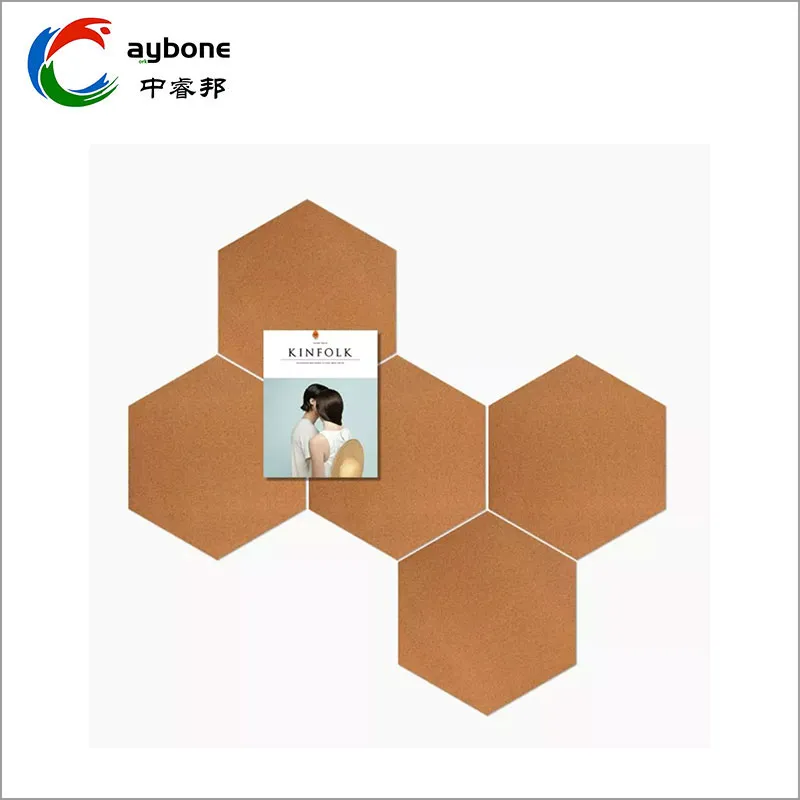
The shift is practical, but it is also visual. A cluster of hexagons reads as an intentional design element rather than a utilitarian notice board. The honeycomb pattern brings order to the arrangement while the natural cork tone softens the wall. This dual role—organization plus decoration—explains why the format has moved from office supply catalogs into interior design conversations.
2. Why the Hexagon Shape Matters
2.1 Tessellation Without Wasted Gaps
Regular hexagons tessellate. When edges align, the tiles cover a surface without the irregular gaps that appear between circles or the directional bias of rectangles. That property matters for two reasons. First, a continuous cork surface gives pins a predictable landing zone anywhere inside the cluster. Second, the pattern remains visually balanced even when the cluster has an uneven outline.
2.2 Expansion in Six Directions
A square tile can only expand along four axes. A hexagon tile can be added at any of six edge positions. This changes how a wall composition grows over time. A user can extend a cluster horizontally, drop a new tile below an existing one, or create a stepped silhouette that follows the architecture of a room. The Hexagon Cork Board Tiles Self Adhesive Pin Board format therefore supports incremental planning. There is no need to predict the final size at the moment of first installation.
2.3 Visual Weight and Softness
Sharp corners draw the eye and create hard edges. Rounded hexagon corners diffuse that visual weight. In a living room or a bedroom, the result is a display surface that feels softer than a framed rectangular board. In a classroom or a collaborative workspace, the pattern communicates structure without feeling institutional.
3. What Cork Delivers Beyond Pin Holding
Cork is not a synthetic substitute for wood. It is the outer bark of the cork oak, harvested without felling the tree. The material is composed of suberin-rich cells that give it elasticity, low density, and resistance to moisture. Those properties translate into several practical behaviors on a wall.
3.1 Self-Healing Surface
When a pushpin enters cork, it pushes the cell walls aside. When the pin is removed, the elastic cells flex back and the opening closes. The surface does not accumulate a grid of permanent holes the way some softer fiberboards do. A wall used daily for reminders, photos, and schedules keeps a clean face because the cork recovers between uses.
3.2 Firm Pin Grip
High-density cork holds pins securely. Papers do not slide downward under their own weight, and light objects remain where they are placed. The backing layer on a well-made tile adds stability, preventing the pin from pushing through to the wall behind. This combination—surface grip plus backing support—is what separates a functional pin board from a decorative cork sheet.
3.3 Thermal and Moisture Buffering
Cork contains a high proportion of trapped air. That structure slows heat transfer and helps moderate small moisture fluctuations. On an interior wall, the effect is modest but noticeable: the surface does not feel cold to the touch, and the material resists the swelling that can affect paper-faced boards in humid conditions.
Natural cork varies slightly in shade and grain. Tiles from the same production batch are matched closely, but minor tonal variation is a characteristic of the material rather than a defect. This variation often improves the visual result because the wall composition reads as a natural surface rather than a printed pattern.
4. Acoustic Behavior in Real Rooms
Cork is frequently described as a sound-absorbing material. That description is accurate but incomplete. Cork wall panels typically fall in the moderate absorption range, with published noise reduction coefficients around 0.20 under standard testing conditions[reference:0]. This means cork absorbs a portion of mid-to-high frequency energy while reflecting the rest. It is not a replacement for dedicated acoustic insulation in a recording studio, but it does reduce the sharpness of reflected sound in everyday rooms.
4.1 Where the Effect Is Most Useful
- Home offices with hard floors and bare walls, where video calls sound hollow without soft surfaces.
- Classrooms and meeting rooms where multiple conversations create a persistent background hum.
- Bedrooms and reading corners where a quieter reflected sound field supports concentration.
- Open-plan kitchens and dining areas with tile or stone surfaces that bounce sound.
4.2 What the Tiles Cannot Do
An acoustic panel system requires coverage, air gap, and often a specific mounting depth to achieve high absorption. A cluster of adhesive cork tiles is a surface treatment, not a tuned acoustic device. Users should expect a subtle improvement in perceived echo and speech clarity rather than a measurable reduction in low-frequency sound transmission between rooms.
5. Layout Patterns and Visual Strategy
The arrangement of hexagon tiles determines whether the result reads as a deliberate design feature or a collection of leftover pieces. Three layout families work reliably across different wall sizes and room functions.
5.1 Tight Honeycomb
Edges touch and the pattern forms a continuous field. This is the most space-efficient arrangement and the best choice when the goal is maximum pin area. A tight honeycomb reads as a single surface with a geometric edge. It suits a home office wall behind a desk, a kitchen command center, or a classroom display zone.
5.2 Spaced Grid
Small, even gaps separate the tiles while the overall alignment remains regular. The gaps introduce wall color into the composition, which lightens the visual weight of the cluster. Spaced layouts suit lighter walls and smaller rooms where a solid block of cork would feel heavy. The spacing also makes it easier to remove a single tile for cleaning or replacement without disturbing neighbors.
5.3 Organic Clusters
Tiles are grouped into irregular islands that step across the wall rather than filling a rectangle. This approach works well on walls with architectural interruptions such as a window, a door frame, or a sloped ceiling. The cluster can wrap around the obstacle instead of competing with it. A Hexagon Cork Board Tiles Self Adhesive Pin Board layout of this kind feels composed rather than constrained.
| Layout type | Best use case | Visual effect | Pin area efficiency |
|---|---|---|---|
| Tight honeycomb | Maximum display space; dense note walls | Continuous surface with a geometric outline | High |
| Spaced grid | Lighter walls; smaller rooms; easier maintenance | Airy and ordered; wall color visible between tiles | Moderate |
| Organic cluster | Walls with windows, doors, or irregular architecture | Sculptural and site-specific | Variable |
6. Matching Tiles to Different Spaces
6.1 Home Office
A home office wall often carries competing demands: a calendar, active project notes, reference cards, and a few personal items. A tight honeycomb cluster above or beside the desk creates a single visual destination for all of that material. Keeping the cluster within arm’s reach from a seated position is more useful than spreading tiles across the room.
6.2 Kitchen and Entryway
These transitional spaces benefit from a small, high-turnover display: shopping lists, school notices, appointment cards, and keys on a pin. A spaced grid of three to six tiles is usually sufficient. Cork’s resistance to moisture fluctuations makes it more suitable near a kitchen than paper-faced boards, though direct contact with water should still be avoided.
6.3 Classroom
Teachers use wall space for schedules, student work, vocabulary cards, and rotating displays. The modular nature of the tiles allows a display zone to grow as the school year progresses. A cluster can start small in September and expand in January without replacing the original installation. The self-healing surface is valuable in a room where the same spot is pinned and unpinned many times per week.
6.4 Studio and Creative Workspace
Designers, photographers, and makers often work with reference material that changes rapidly. A large cork field supports mood boards, swatches, sketches, and printed proofs without the need for frames or tape. The natural tone of cork provides a neutral background that does not compete with the colors of the pinned material.
7. Installation That Stays Put
The adhesive backing is the most consequential component of a self-adhesive tile. A weak adhesive allows tiles to lift at the edges; an overly aggressive adhesive can remove paint during removal. The outcome depends as much on surface preparation as on the adhesive itself.
7.1 Surface Compatibility
- Smooth, dry, and dust-free surfaces are suitable: painted plaster, tile, glass, sealed wood, and metal.
- Textured wallpaper, fabric-covered walls, and freshly painted surfaces are not suitable until the paint has fully cured.
- Damaged or flaking paint should be repaired before installation because the adhesive will bond to the loose layer rather than the wall.
- Cold surfaces below the adhesive’s operating range should be avoided; most pressure-sensitive adhesives perform best at normal indoor temperatures.
7.2 Step-by-Step Application
- Clean the wall with a damp cloth and allow it to dry completely. A final wipe with a dry microfiber cloth removes dust that can interfere with adhesion.
- Arrange the tiles on the floor or a table in the intended pattern. This step reveals whether the cluster fits the available wall space and whether the edge alignment looks balanced.
- Mark the position of the first tile with a light pencil line or a strip of painter’s tape. The first tile establishes the geometry for every subsequent tile.
- Peel the protective film from the back of the first tile and press it firmly against the wall for several seconds, applying pressure across the entire surface rather than only at the center.
- Position the remaining tiles one at a time, using the flat edges of the installed tiles as guides. Press each tile firmly after placement.
- Once all tiles are in place, run a clean hand or a soft cloth across the cluster to reinforce the bond. Avoid hanging heavy items immediately; allow the adhesive to settle for the period recommended by the manufacturer.
The adhesive used on many self-adhesive cork tiles is strong enough to remove paint from painted walls during removal[reference:1]. Users who intend to remove the tiles later should test a small area first or choose a surface where paint loss is not a concern. Repositioning is difficult after the adhesive contacts the wall, so the floor-planning step is essential.
8. Maintenance and Long-Term Care
Cork is a low-maintenance material, but it is not maintenance-free. Dust settles on the textured surface, and oils from fingers can create darker patches over time. A simple routine keeps the surface even and the adhesive secure.
8.1 Routine Cleaning
- Dust the tiles every few weeks with a dry microfiber cloth or a soft brush vacuum attachment.
- For marks, wipe gently with a cloth dampened with mild soap and water, then dry immediately.
- Avoid soaking the tiles; excess water can migrate toward the adhesive layer and weaken the bond.
- Do not use abrasive cleaners, solvent-based products, or scouring pads, which can damage the cork surface.
8.2 Edge Lifting and Repair
An edge that lifts slightly can often be reseated by applying firm pressure with a warm finger or a soft cloth. If the adhesive has lost tack, a small piece of double-sided adhesive tape cut to fit the lifted area can restore the bond without removing the tile. Tiles that have deformed or absorbed moisture should be replaced rather than forced back into place.
8.3 Pin Management
Use standard pushpins with a shaft length shorter than the combined thickness of the cork and its backing. Oversized pins can create deep channels that reduce the self-healing effect. Rotating pin positions within the same tile helps distribute wear across the surface.
9. Cork Tiles Compared with Alternative Boards
Several wall display products compete for the same space. Each has a different balance of cost, installation complexity, acoustic behavior, and visual character. The table below compares common options on functional criteria rather than price.
| Feature | Self-adhesive cork hexagon tiles | Framed cork board | Felt pin tiles | Whiteboard panel |
|---|---|---|---|---|
| Installation method | Peel-and-stick; no tools on suitable surfaces | Usually requires screws or hanging hardware | Peel-and-stick or adhesive pads | Adhesive or screw mounting |
| Pin holding | Firm grip; self-healing surface | Firm grip; surface may show wear over time | Moderate grip; felt can retain pin marks | Not designed for pins |
| Acoustic contribution | Moderate absorption; reduces reflected sharpness | Similar to cork tiles | Moderate to high absorption depending on density | Reflective surface; can increase echo |
| Layout flexibility | High; expandable in multiple directions | Fixed rectangle | Modular if sold as tiles | Usually fixed panel sizes |
| Visual character | Natural cork tone; geometric pattern | Frame defines the look | Soft fabric texture; wide color range | Glossy or matte white |
| Removal impact | Adhesive may lift paint on painted walls | Screw holes remain | Adhesive may lift paint | Adhesive residue or screw holes |
The comparison clarifies the trade-off. A framed board is a finished object with a defined border. A whiteboard is unmatched for dry-erase writing but does not accept pins. Felt tiles offer color variety but may record permanent pin marks. The Hexagon Cork Board Tiles Self Adhesive Pin Board occupies a middle position: natural material, pin-friendly, modular, and acoustically modest but useful.
10. Frequently Asked Questions
Can these tiles be installed on wallpaper?
Wallpaper is generally not recommended. The adhesive bonds to the paper surface, and removing the tile can tear the wallpaper or leave a visible adhesive patch. Textured wallpaper also prevents full contact between the adhesive and the wall, which increases the risk of edge lifting. Smooth, painted walls, tile, glass, and sealed wood are better candidates.
Will the adhesive damage the paint when the tiles are removed?
It can. Many pressure-sensitive adhesives used on wall tiles are strong enough to remove loose or poorly bonded paint during removal[reference:2]. The risk is higher on fresh paint, low-quality paint, and surfaces that were not cleaned before installation. Users who plan to remove the tiles should test the adhesive on a small inconspicuous area first.
How much weight can a single tile hold?
Weight capacity depends on the density of the cork, the thickness of the backing, the type of pin, and the condition of the wall surface. Standard pushpins in a quality tile can hold paper sheets, photos, and lightweight cards without difficulty. Heavy objects, thick stacks of paper, or items that create leverage on the pin should be distributed across multiple pins or avoided.
Do the tiles leave gaps between them?
In a tight honeycomb arrangement, the flat edges align closely, but a hairline seam may remain due to manufacturing tolerances and the natural texture of cork. These seams do not affect pin holding because the backing layer provides continuity. Spaced layouts intentionally create larger gaps as a design choice.
Can the tiles be cut to fit an awkward space?
Yes. Cork can be cut with a sharp utility knife or heavy-duty scissors. For a clean edge, score the surface first and cut gradually rather than forcing the blade through the full thickness in one pass. Cut edges expose the raw cork interior, which is visually consistent with the surface but may shed a small amount of dust initially.
Are the tiles suitable for a bathroom or a humid climate?
Cork resists moisture better than paper-faced boards, but prolonged exposure to steam and direct water contact should be avoided. In a bathroom, install the tiles away from the shower and ensure the room has adequate ventilation. Wipe any condensation from the surface promptly.
How many tiles are needed for a typical desk-area wall?
A useful starting point is a cluster of six to twelve tiles in a tight honeycomb, covering roughly the width of the desk plus a small margin. Larger walls or walls that need to hold a calendar, active project notes, and reference material may require more. Because the system is modular, starting smaller and expanding later is a practical strategy.
Do the tiles need a frame or additional support?
No. Each tile is a complete unit with its own adhesive backing. A frame is not required for structural support, and adding one would remove the layout flexibility that makes the hexagon format useful. The only exception is a wall surface that cannot accept adhesive; in that case, a thin plywood backing panel can be mounted first and the tiles applied to the panel.
Ready to Turn Empty Wall Space into a Working Display Surface?
Professional production experience and a focus on authentic cork quality make Raybone a reliable partner for bulk orders, custom projects, and consistent supply.
Have a wall size, a layout idea, or a project timeline? Contact us today to discuss your requirements and receive a practical response from the team.
Get in Touch — Contact UsResponse within one business day. Project-specific guidance available.